I Let AI Refactor a Legacy .NET API. Here's What It Got Wrong.
By Kamlesh Bhor · 📅 08 Sep 2026 · 👁️ 2
Author: Kamlesh Bhor · DotNet Wisdom
Audience: mid / senior .NET folks shipping AI-assisted changes
Sample companion: runnable demo under samples/ (download the article pack or clone when the repo is public) — break it, fix it
When I first pasted a messy Orders API into an AI chat and typed "make this production-ready," I felt like I'd unlocked a cheat code. Clean names. Proper DI. Happy-path tests green in seconds.
But let's be honest — AI does not know what your code is supposed to do. It knows what code *looks like*. Those are different skills. I learned that the hard way (on a teaching demo I built on purpose — more on that honesty note below).
This article walks you through what I hit, the prompt that caused the damage, the better prompt that fixed it, and the checklist I now refuse to merge without.
In this article
- ▶ Run it — download the sample pack / open
samples/(GitHub Actions workflow included for when you push the repo) - 📋 Steal the prompt — v1 vs v2 in
toolkit/Steal-These-Prompts.md - ✅ Checklist —
toolkit/AI-Refactor-Review-Checklist.md - 🎬 Video — long-form + Shorts outline in
REPURPOSE.md(record when you’re ready)
🙋 Honesty first
The Orders API in this pack is a condensed teaching demo (a few hundred lines of Controllers-style ASP.NET Core 8). It is not a fake 10k-line production dump I "found in a drawer."
I built the quirks in so we can learn together. Same failure modes you'll hit on a real system — employee discounts, banker's rounding, shipped no-ops, off-by-one paging, auth stubs cleaned away — just small enough that you can download the pack, run it, and see the red/green yourself.
The scenario I started with
I inherited (okay — I wrote) a small but ugly Orders API:
- Poor names (
OrdCtrl,DoStuff,StuffHelper,x1,tmp) - Duplicated validation and totals math
- Fat controller with business rules inline
- Static helpers instead of DI
- Almost no tests
- Hidden rules that still matter (see
samples/LegacyOrdersApi/README.md):
| Rule | Behavior |
|---|---|
| A. Shipped + remove-line | Silent no-op — order unchanged |
| B. EMP- discount | Only if CustomerType == Internal; otherwise ignore (no error) |
| C. EU tax rounding | MidpointRounding.ToEven (banker's) to 2 decimals |
| D. Rate limit | Max 3 creates per customer id per minute |
export PATH="$HOME/.dotnet:$PATH"
cd samples/LegacyOrdersApi
dotnet build
dotnet run --urls http://localhost:5080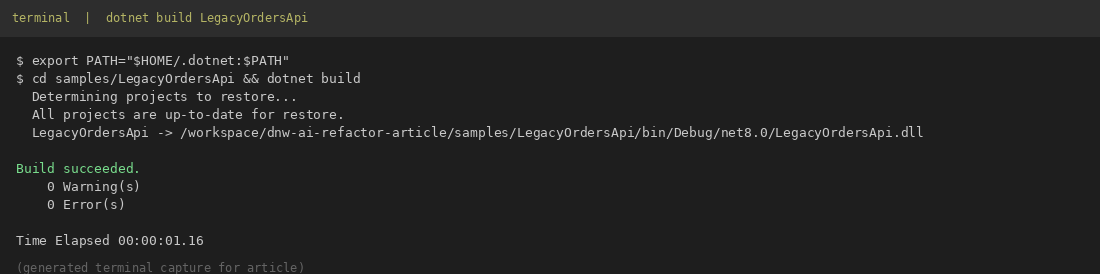
Legacy ASP.NET Core Orders API build succeeding
📌 Tip: Install the .NET 8 SDK. If dotnet isn’t on your PATH after install, add it (on Linux/macOS that’s often export PATH="$HOME/.dotnet:$PATH"). Document the same SDK in CI.
Prompt v1 — the one that caused damage
Saved as samples/PROMPT_USED.md:
Refactor this ASP.NET Core Orders API for production readiness.
Improve naming, remove duplication, introduce proper DI, modern C# patterns,
add unit tests, and clean up anything that looks unused or outdated.
Preserve behavior.
That last sentence *sounds* responsible. Models are great at the first four bullets. They are not automatically great at the fifth — especially when "unused looking" code is load-bearing.
What the AI improved (I won't deny it)
The refactored tree (samples/AiRefactoredOrdersApi/) is genuinely nicer in several ways:
Naming and structure
// Before
public class OrdCtrl : ControllerBase { ... public IActionResult DoStuff(...) }

// After
public class OrdersController : ControllerBase { ... public async Task<IActionResult> Create(...) }
DI instead of static grab-bags
builder.Services.AddSingleton<IPricingService, PricingService>();
builder.Services.AddScoped<IOrderService, OrderService>();
Deduplicated pricing/totals into PricingService / OrderService.
Happy-path unit tests that pass and give you false confidence:
dotnet test samples/CorrectBehaviorTests --filter FullyQualifiedName~AiHappyPathTests
# Passed: 3
If you only look at structure and green happy paths… yeah. You would merge this. I almost did.
🚨 I almost merged this
Here's the beat I want you to feel, because I felt it.
Happy-path tests: green. Naming: OrdersController, IPricingService, IOrderService — looked senior. DI wired. Swagger still opened. Create-order returned 201.
I hovered over "Approve PR."
Then I ran the characterization / regression suite I had written against the legacy rules — and watched it light up red:
dotnet test samples/CorrectBehaviorTests \
  --filter "FullyQualifiedName~AiRegressionTests|FullyQualifiedName~AiSecurityRegressionTests"
# Failed: 6  ← that is the point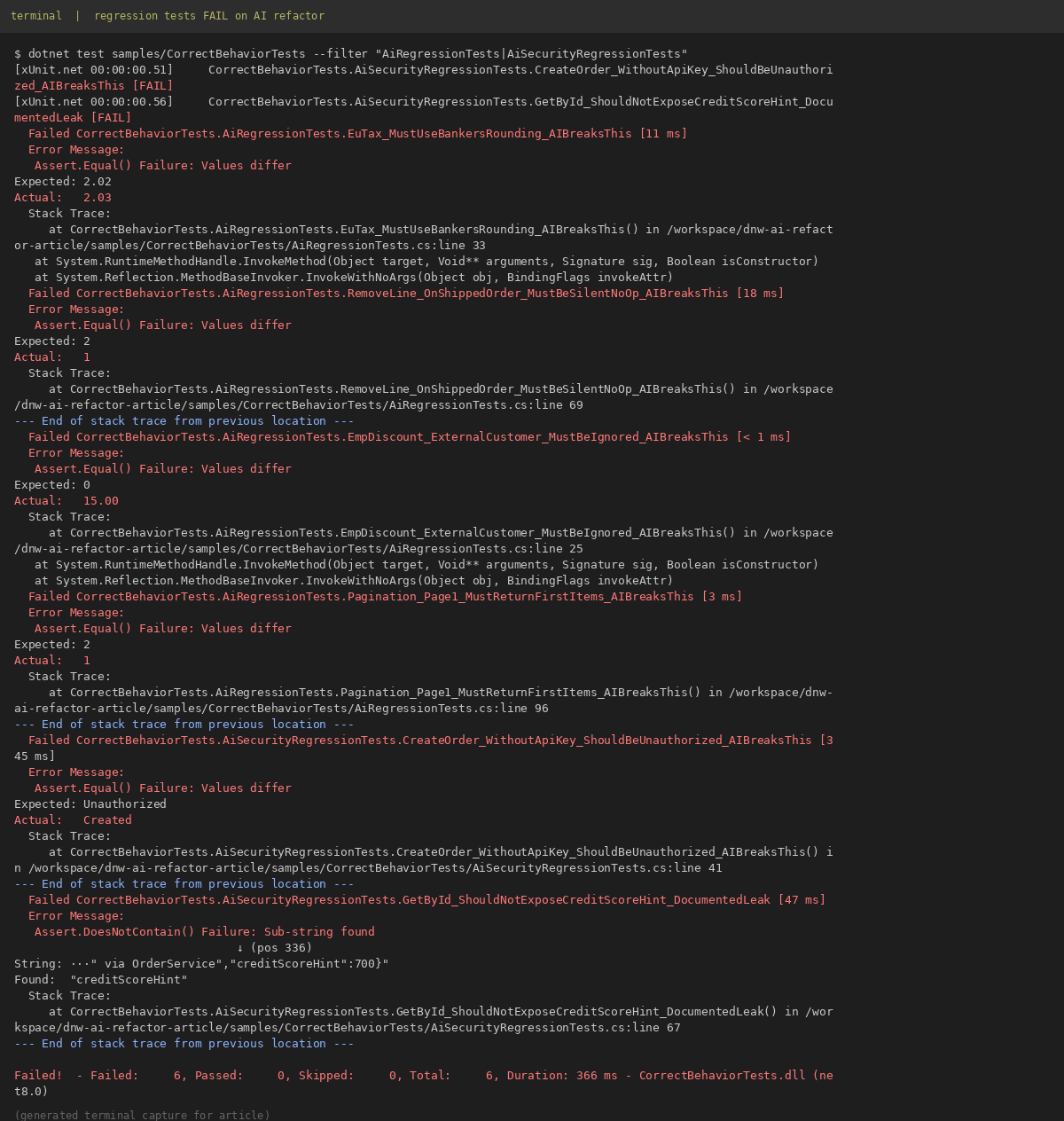
Regression tests failing on the AI-refactored Orders API
🎯 The lesson: green happy paths mean the wiring works. They do not mean EMP- on an external customer still behaves. I noticed EMP- applying to an External customer only because the characterization test said Expected 0, Actual 15.
Learn from my mistakes: write those tests before you ask the model to refactor — or you will accidentally encode the new (wrong) behavior.
What the AI got wrong (with live numbers)
Every mistake below is real code in the demo, caught by CorrectBehaviorTests.
1. "Simplified" the EMP- discount quirk
Legacy (StuffHelper.CalcDisc) — employee codes only for internal customers:
if (code.StartsWith("EMP-", StringComparison.OrdinalIgnoreCase))
{
    if (customerType != "Internal")
        return 0m; // ignore without error
    return Math.Round(sub * 0.15m, 2);
}
AI (PricingService.CalculateDiscount) — always applies 15%:
if (code.StartsWith("EMP-", StringComparison.OrdinalIgnoreCase))
    return Math.Round(subtotal * 0.15m, 2);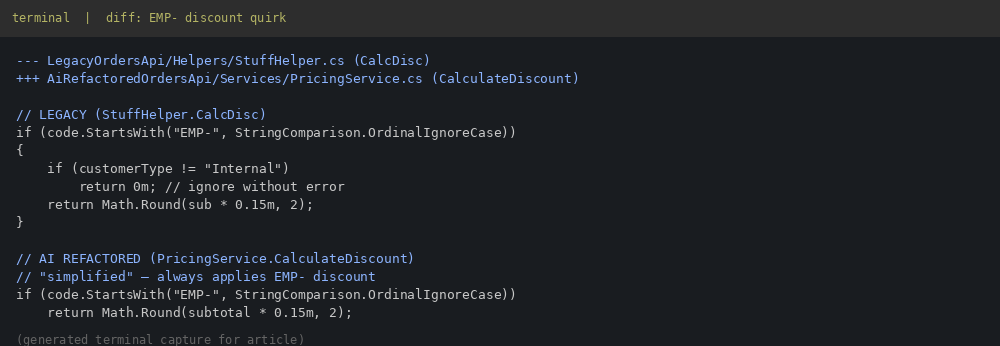
Before and after EMP- discount quirk: legacy vs AI simplification
📌 Live number AI can't fake: External customer + code EMP-SAVE on ₹100 subtotal → correct discount ₹0 → AI wrong discount ₹15
Finance notices weeks later. The model followed "clean up special cases" energy from the prompt — and violated "Preserve behavior."
Proof: AiRegressionTests.EmpDiscount_ExternalCustomer_MustBeIgnored_AIBreaksThis
2. Deleted EU banker's rounding as "dead code"
Legacy — looks redundant next to a plain Math.Round, but MidpointRounding differs on .5 edges:
if (region == "EU")
{
    // DO NOT delete — finance reconciliation depends on this
    return Math.Round(raw, 2, MidpointRounding.ToEven);
}
return Math.Round(raw, 2, MidpointRounding.AwayFromZero);
AI — one path for all regions:
return Math.Round(raw, 2, MidpointRounding.AwayFromZero);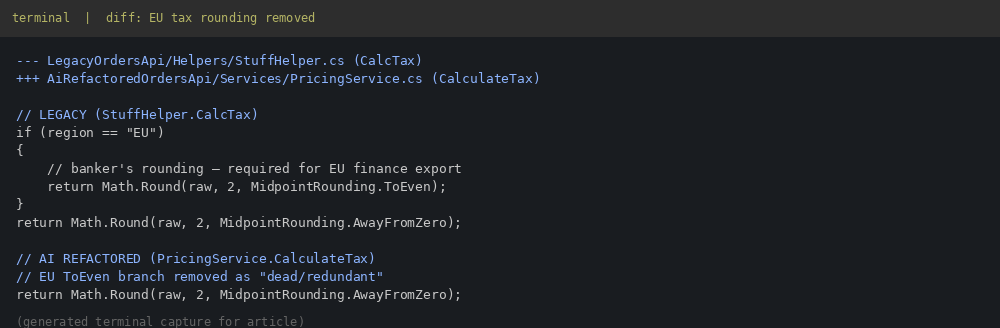
Before and after EU banker’s rounding tax logic
📌 Live number AI can't fake: taxable 10.125, EU rate 20% → raw 2.025 → ToEven = 2.02 (correct) → AwayFromZero = 2.03 (AI)
Now multiply that 1-cent drift by × 50,000 invoices. Suddenly "dead looking" code is a reconciliation war room.
Proof: AiRegressionTests.EuTax_MustUseBankersRounding_AIBreaksThis
3. Subtle behavioral bugs while "cleaning up"
Pagination off-by-one — legacy is 1-based (Skip((page - 1) * size)). AI used Skip(page * size), so page=1 skips the first page.
Shipped orders mutated — legacy silent no-op when Status == "Shipped". AI compared to "shipped" (lowercase), so the guard never hits and lines get removed from shipped orders.
if (order.Status == "shipped") // never true for real "Shipped"
{
    return (order, null, 200);
}
// falls through and removes the line
Proof: RemoveLine_OnShippedOrder_MustBeSilentNoOp_AIBreaksThis, Pagination_Page1_MustReturnFirstItems_AIBreaksThis
4. Over-engineered abstractions for an in-memory list
AI introduced IRepository<T> + IUnitOfWork wrapping a static List<Order>. For this demo store that is ceremony without benefit.
Over-engineering is not a test failure; it is a review failure. Push back.
5. Security stub removed; internal fields still leaked
Legacy mutating endpoints required X-Api-Key: legacy-demo-key. AI deleted OkKey() as "outdated." Creates now return 201 with no key.
The model also kept CreditScoreHint on the public JSON shape — improved naming, same data leak.
Proof: AiSecurityRegressionTests
Prompt v2 — the one I wish I'd used first
Full text: samples/PROMPT_V2_FIXED.md (also side-by-side in toolkit/Steal-These-Prompts.md).
Refactor this ASP.NET Core Orders API for production readiness.

BEFORE changing production code:
1. Read and respect every characterization / regression test already in the repo.
2. Do not delete, merge, or "simplify" branches that have finance, auth, rate-limit,
   or "do not remove" comments — treat those as load-bearing.
3. If a branch looks redundant (e.g. MidpointRounding.ToEven vs AwayFromZero),
   KEEP IT unless a test proves it is dead.

Preserve these exact business quirks (non-negotiable):
- EMP- discount codes apply ONLY when CustomerType == "Internal".
  Example: External + EMP-SAVE on subtotal 100 → discount 0 (NOT 15).
- EU tax uses MidpointRounding.ToEven … raw 2.025 → EU 2.02 (not 2.03).
- Status == "Shipped" remove-line is a silent no-op.
- Pagination is 1-based: Skip((page - 1) * size).
- Mutating endpoints require X-Api-Key: legacy-demo-key.
- Do NOT expose CreditScoreHint / InternalNotes on public JSON — use a response DTO.

Allowed improvements: naming, DI, dedupe. Prefer simple services over generic
Repository + UnitOfWork for an in-memory list.
Preserve behavior. Prove it with the existing characterization suite.
Contrast: v1 vs v2 outcomes
Prompt v1 → AiRefactoredOrdersApi |
Prompt v2 → PromptFixedOrdersApi |
|
|---|---|---|
| Naming / DI | ✅ nicer | ✅ nicer |
| EMP- External ₹100 | ❌ ₹15 | ✅ ₹0 |
| EU raw 2.025 | ❌ 2.03 | ✅ 2.02 |
| Shipped no-op | ❌ mutates | ✅ silent no-op |
| Page 1 | ❌ skips first page | ✅ first page |
| Auth header | ❌ removed | ✅ kept |
creditScoreHint |
❌ leaked | ✅ stripped via OrderResponse |
| Regression suite | fails | passes |
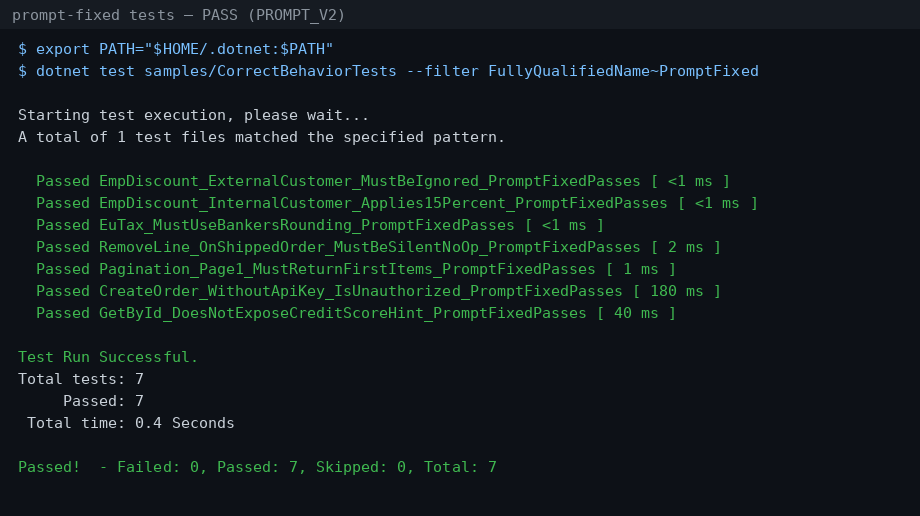
Prompt-fixed Orders API regression tests all passing
When I applied the better prompt (and kept characterization tests as the source of truth), I got clean structure without deleting the quirks. That's the whole game.
Testing AI's refactoring (step by step)
| Layer | What to run | What it catches |
|---|---|---|
| Happy-path unit | AiHappyPathTests |
Naming/wiring — *not* legacy quirks |
| AI regression | AiRegressionTests + AiSecurityRegressionTests |
EMP-, EU rounding, shipped, paging, auth, leak |
| Prompt-fixed | PromptFixedRegressionTests + PromptFixedSecurityTests |
Same quirks — expect pass |
| Legacy baseline | LegacyBehaviorTests |
Original rules still hold |
| CI | .github/workflows/ci.yml |
Legacy + prompt-fixed must pass; job ai-refactor-should-fail documents the lesson |
export PATH="$HOME/.dotnet:$PATH"
cd dnw-ai-refactor-article   # folder from the sample pack (or your repo root)

# 1) Legacy — expect PASS
dotnet test samples/CorrectBehaviorTests --filter FullyQualifiedName~LegacyBehaviorTests

# 2) AI happy path — expect PASS (false confidence)
dotnet test samples/CorrectBehaviorTests --filter FullyQualifiedName~AiHappyPathTests

# 3) AI regressions — expect FAIL (that's the point)
dotnet test samples/CorrectBehaviorTests \
  --filter "FullyQualifiedName~AiRegressionTests|FullyQualifiedName~AiSecurityRegressionTests"

# 4) Prompt-fixed — expect PASS
dotnet test samples/CorrectBehaviorTests \
  --filter "FullyQualifiedName~PromptFixedRegressionTests|FullyQualifiedName~PromptFixedSecurityTests"
✅ Write characterization tests against legacy behavior before you ask the model to refactor.
✅ Practical checklist (steal from toolkit/)
Copy/paste the full version: toolkit/AI-Refactor-Review-Checklist.md
Quick version:
- 1. Diff every deleted branch — finance comments, MidpointRounding, silent ignore
- 2. Search EMP- / partner codes / "ignore without error"
- 3. Compare status casing —
"Shipped"vs"shipped" - 4. Re-check paging —
page=1must be the first page - 5. Auth still required on mutating endpoints?
- 6. Response DTOs — no
creditScoreHint - 7. Run regression on the AI output, not only AI's happy paths
- 8. Refuse Repository + UoW over one
List<T>unless you have a second implementation - 9. Keep "preserve behavior" measurable — characterization tests are that measurement
- 10. Prefer prompt v2 (
PROMPT_V2_FIXED.md) once tests exist
Starter xUnit file: toolkit/Characterization-Test-Template.cs
Core lesson
AI is excellent at changing code. It is not automatically good at deciding which code should change.
When I treat model output like a junior PR — useful, fast, and never merge-ready without characterization tests — I sleep better. When I don't, External customers get employee pricing and EU finance starts Slack-paging me about cents.
🙋 FAQ
Q: Do I need to ban AI from refactors? A: No. I still use it for naming, DI wiring, and dumping duplication. I just don't let it be the source of truth for quirks.
Q: Why not only review the diff by eye? A: Because I almost merged this. Eyes love pretty names. Tests love boring numbers like ₹0 vs ₹15.
Q: Is PromptFixedOrdersApi "what the AI would produce with v2"? A: It's the teaching outcome of applying v2's constraints — good structure, quirks preserved, leak closed. Use the prompt on your own codebase; use this sample to verify your review habits.
Q: Where's CI? A: .github/workflows/ci.yml — builds the solution, runs legacy + prompt-fixed (must pass), and a separate job ai-refactor-should-fail that succeeds only when the AI regression suite fails as expected.
Reproduce this article's demo
export PATH="$HOME/.dotnet:$PATH"
cd dnw-ai-refactor-article

dotnet build OrdersApiDemo.sln
dotnet test samples/CorrectBehaviorTests --filter FullyQualifiedName~LegacyBehaviorTests
dotnet test samples/CorrectBehaviorTests --filter FullyQualifiedName~AiRegressionTests
dotnet test samples/CorrectBehaviorTests --filter FullyQualifiedName~PromptFixedRegressionTests
Files to open first:
samples/PROMPT_USED.md— v1 (damage)samples/PROMPT_V2_FIXED.md— v2 (safer)samples/LegacyOrdersApi/Helpers/StuffHelper.cs— EMP- + EU roundingsamples/AiRefactoredOrdersApi/Services/PricingService.cs— simplified (wrong)samples/PromptFixedOrdersApi/Services/PricingService.cs— quirks restoredsamples/CorrectBehaviorTests/— the truthtoolkit/— checklist, template, steal-these-prompts
Comment CTA
🎯 Your turn: which legacy quirk has AI deleted in *your* codebase — a silent no-op, a rounding mode, an auth stub, a 1-based page?
Drop it in the comments. I'm collecting stories for Part 2.
— Kamlesh · DotNet Wisdom

Article by Kamlesh Bhor
Feel free to comment below about this article.
💬 Join the Discussion