AI Wrote My Unit Tests. They All Passed. The Bug Still Shipped.
By Kamlesh Bhor · 📅 17 Sep 2026 · 👁️ 5
AI Wrote My Unit Tests. They All Passed. The Bug Still Shipped.
By Kamlesh Bhor - DotNet Wisdom
When I opened the PR, every test was green. Six of them. The names looked senior. Moq verified the calculator was called. I was one click from merge.
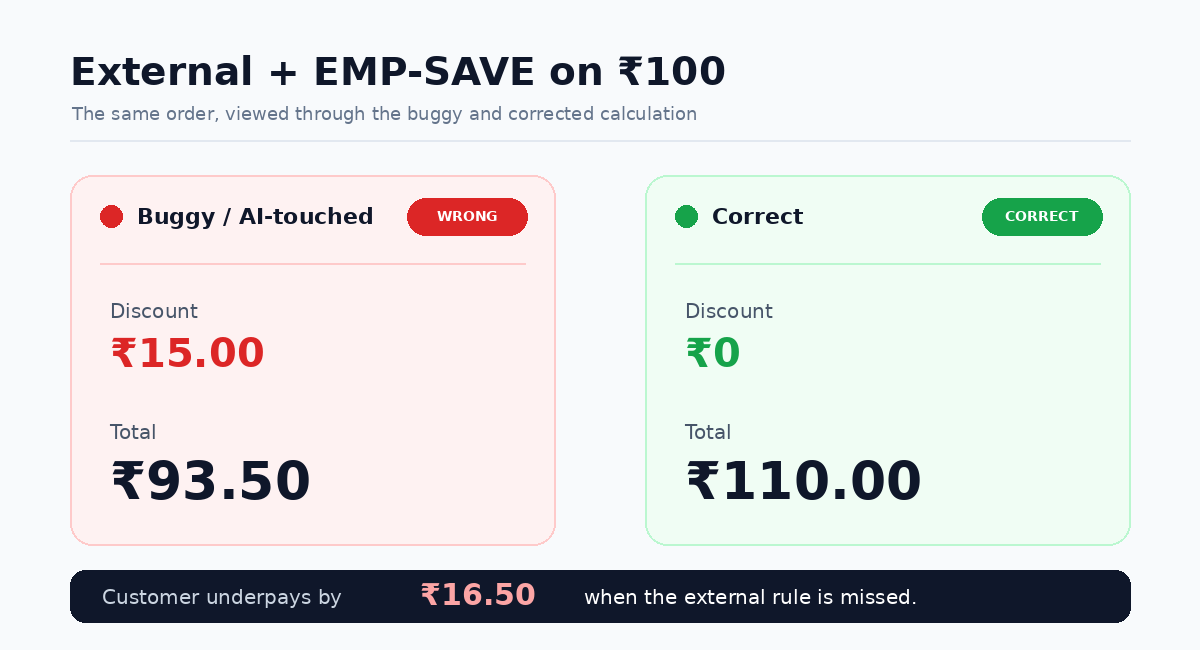
Then I typed one External customer + EMP-SAVE into a tiny console and watched the total print ₹93.50 instead of ₹110.00.
Green does not mean correct. It means the asserts matched whatever the code (or mock) did today. If asserts were copied from buggy output, the suite protects the bug.
TL;DR: AI-style unit tests against a buggy price calculator all passed while an External customer still got an employee discount. The fix was characterization tests for the real rules, then mutation testing.
Honesty first
This is a condensed teaching demo on .NET 10. BuggyPriceCalculator and the weak AiStyle suite are intentional fixtures. Same failure modes: happy paths only, mock call-counts, copied totals, no External+EMP-, and no EU midpoint edge.
The rules that matter
| Rule | Correct behavior |
|---|---|
| EMP- discount | 15% only when CustomerType == Internal; External - discount ₹0 |
| EU tax | 20%, MidpointRounding.ToEven to 2 decimals |
| Non-EU tax | 10%, MidpointRounding.AwayFromZero |
Bugs: EMP- applies to everyone; EU tax uses AwayFromZero. Both calculators ship in src/OrdersPricing/.
Step 1 - AiStyle tests: all green
export PATH="$HOME/.dotnet:$PATH"
dotnet test tests/OrdersPricing.AiStyle.Tests
# Passed: 6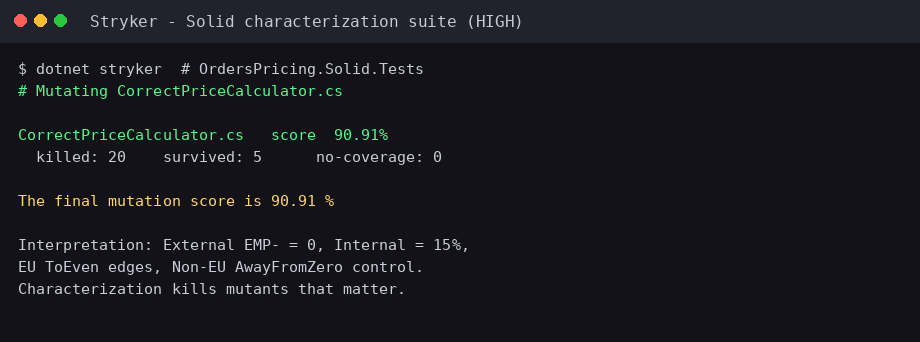
Tip: Install the .NET 10 SDK. If dotnet is not on your PATH, add the exported PATH above.
What those AI-style tests got wrong
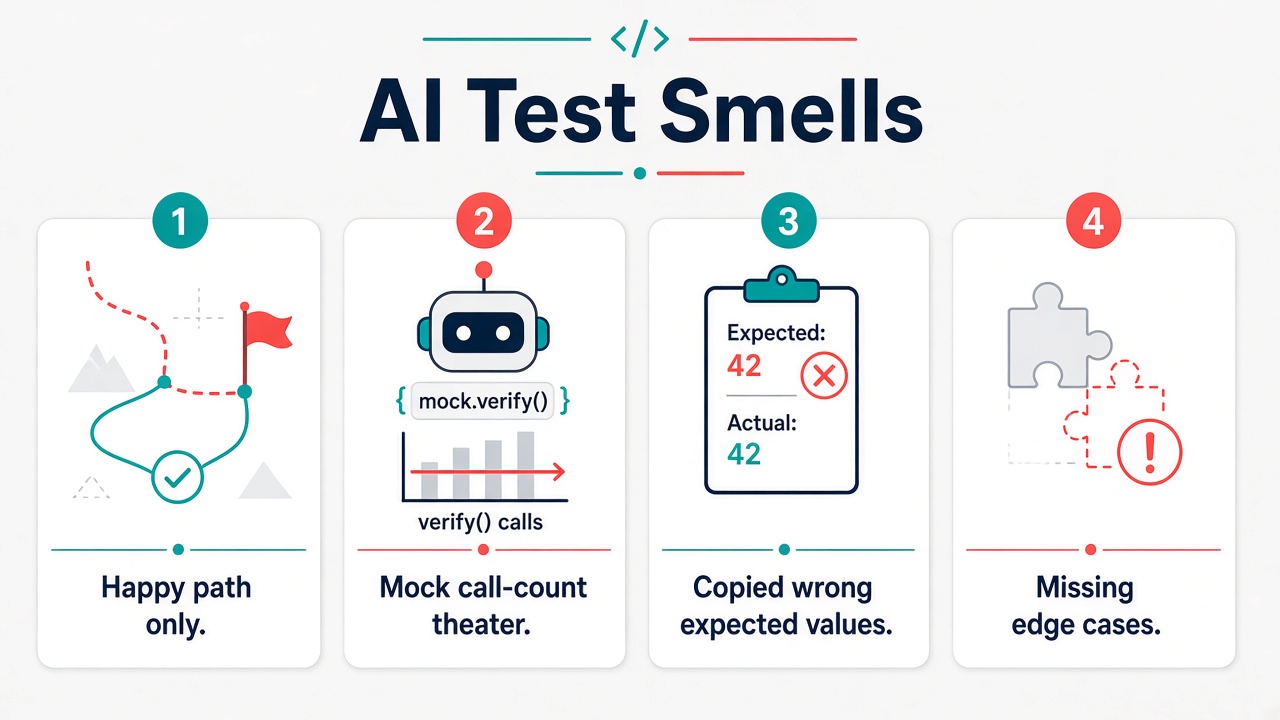
1. Happy path only
// Internal + EMP- only
var result = _sut.Calculate(new PriceRequest(
    Subtotal: 100m, DiscountCode: "EMP-SAVE",
    CustomerType: CustomerType.Internal, Region: "IN"));
Assert.Equal(15.00m, result.DiscountAmount);
Assert.Equal(93.50m, result.Total);
Never asks the scary question: what about External?
2. Assert the mock was called
mock.Verify(c => c.Calculate(It.IsAny<PriceRequest>()), Times.Once);
Assert.Equal(93.50m, result.Total); // total came from the stub
That proves wiring, not the Internal-only business rule.
3. Expected values copied from buggy output
var result = _sut.Calculate(new PriceRequest(
    100m, "EMP-SAVE", CustomerType.External, "IN"));
Assert.Equal(15.00m, result.DiscountAmount); // wrong rule
Assert.Equal(93.50m, result.Total);
The suite notarizes the bug.
4. No edges for EU midpoint
var result = _sut.Calculate(new PriceRequest(
    12.125m, null, CustomerType.External, "EU"));
Assert.Equal(2.43m, result.TaxAmount); // buggy; correct ToEven is 2.42
Happy path + mock theater + copied wrong oracle + missing edges = merge confidence with no business confidence.
Step 2 - The wrong money still ships
dotnet run --project demo/WrongTotalDemo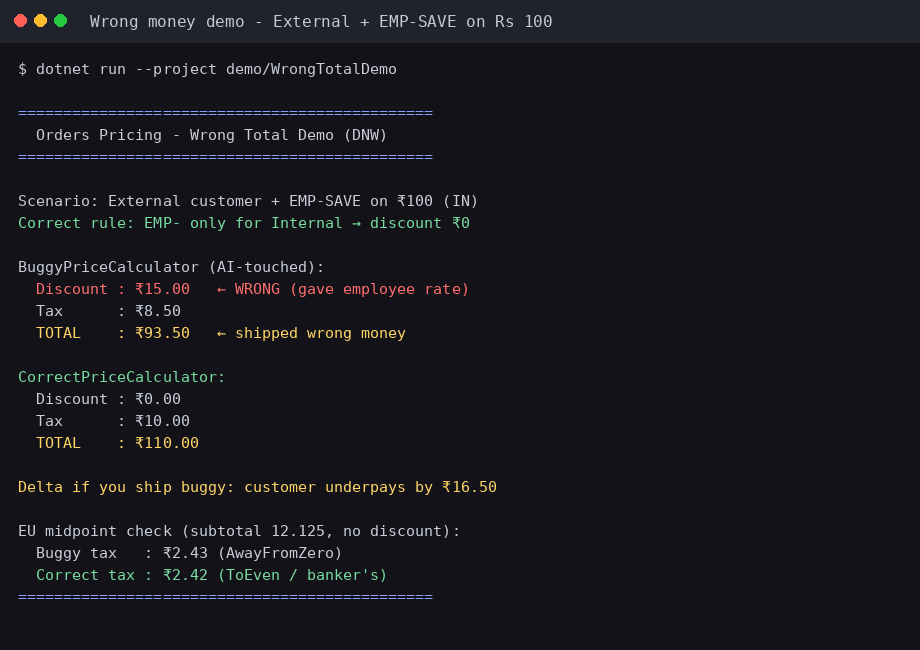
| Scenario | Buggy | Correct |
|---|---|---|
| External + EMP-SAVE, ₹100, IN | discount ₹15.00, total ₹93.50 | discount ₹0, total ₹110.00 |
| Customer underpays by | ₹16.50 | - |
| EU tax on 12.125 | ₹2.43 | ₹2.42 |
Green tests. Wrong money.
Step 3 - Solid specs fail on the buggy code
Write the asserts from the business rules, then point them at BuggyPriceCalculator:
dotnet test tests/OrdersPricing.Solid.AgainstBuggy.Tests
# Failed: 3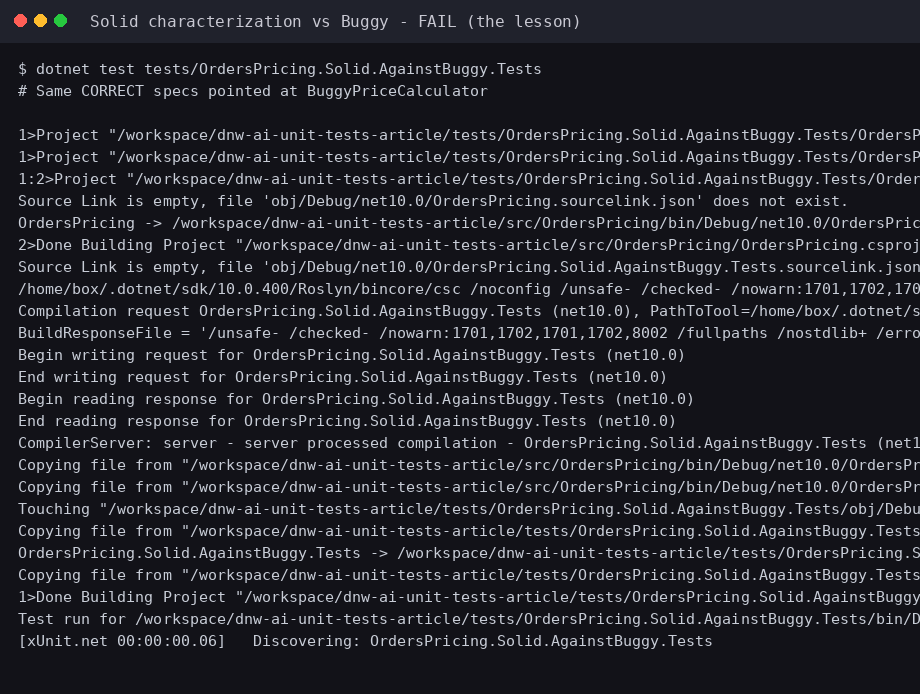
What goes red:
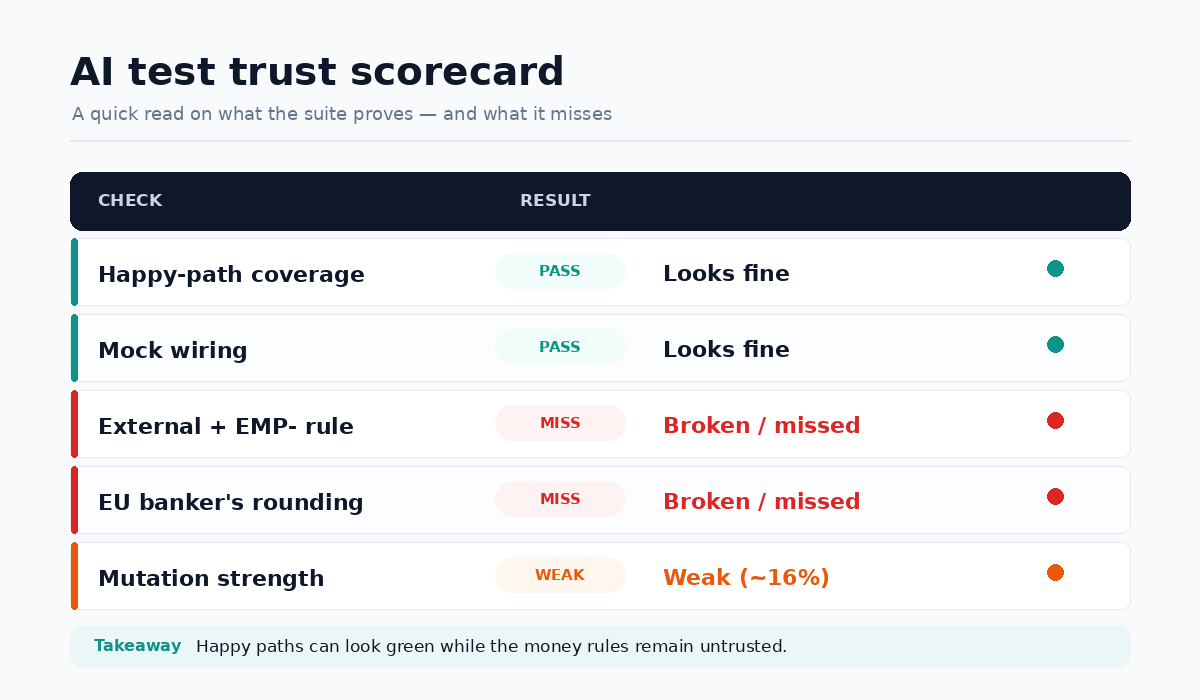
- External EMP- on 100 - expect discount 0 (buggy gives 15)
- EU midpoint 12.125 - expect tax 2.42 (buggy gives 2.43)
- External EMP- total - expect 110.00 (buggy gives 93.50)
Characterization move: red against a known-bad implementation is success. Your specs have teeth.
Step 4 - Correct calculator + Solid green
dotnet test tests/OrdersPricing.Solid.Tests
# Passed: 13
Solid coverage includes External EMP- means 0, Internal EMP- means 15 on 100, EU ToEven edges (12.125 means tax 2.42), Non-EU AwayFromZero control, and boundaries including zero total, negative throws, and case-insensitive codes and regions.
Ship CorrectPriceCalculator in production. Keep BuggyPriceCalculator in the sample so readers can replay the red/green arc.
Step 5 - Mutation testing with Stryker
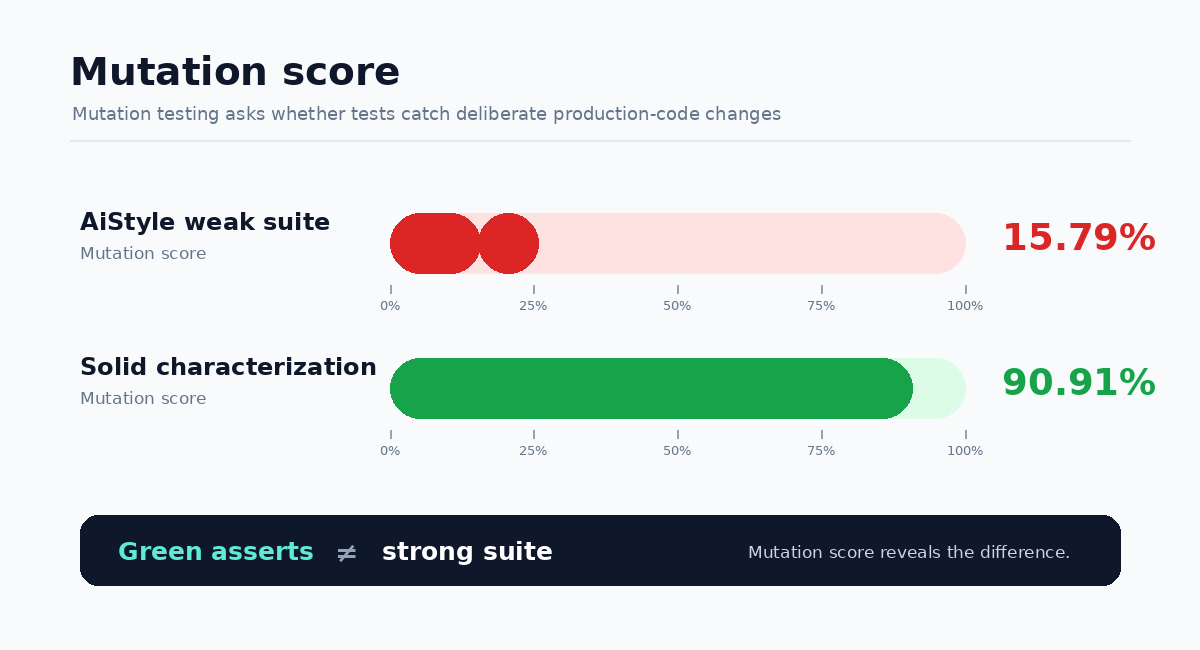
Happy green bars can lie. Mutants are less polite.
dotnet tool restore
cd tests/OrdersPricing.AiStyle.Weak.Tests
dotnet tool run dotnet-stryker --project OrdersPricing.csproj   --mutate "**/BuggyPriceCalculator.cs" --break-at 0
# mutation score ~15.79%

cd ../OrdersPricing.Solid.Tests
dotnet tool run dotnet-stryker --project OrdersPricing.csproj   --mutate "**/CorrectPriceCalculator.cs" --break-at 0
# mutation score ~90.91%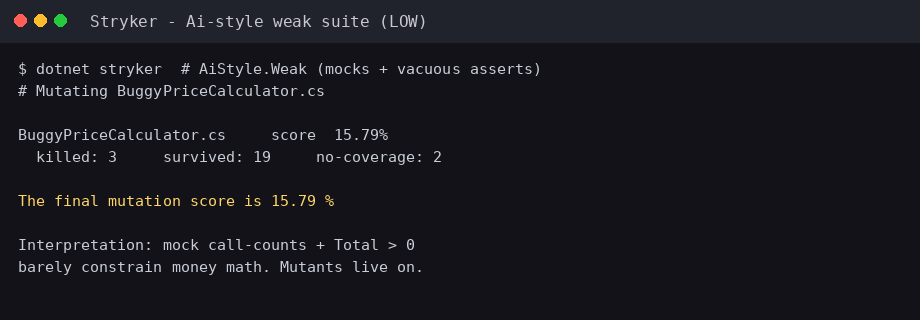
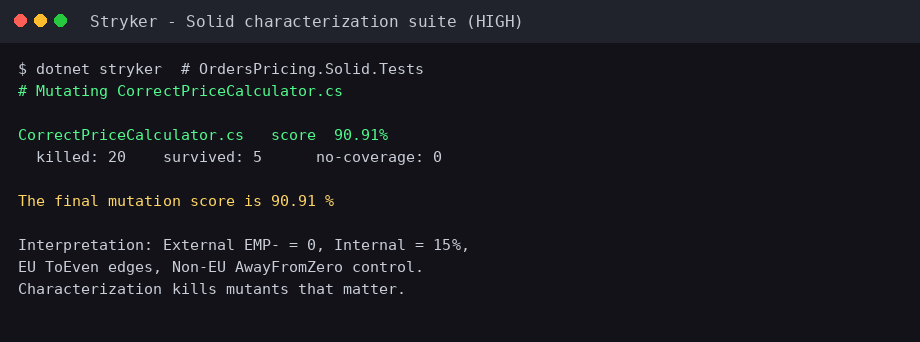
A wrong oracle can still look covered because asserts defend the bug. The weak slice scored ~15.79%. Solid characterization on the correct calculator scored ~90.91%. Reports ship under reports/stryker-aistyle/ and reports/stryker-solid/.
Checklist before you trust AI tests
- Spec the quirks first (Internal-only EMP-, EU ToEven).
- Assert money and state - not only
Times.Once. - Include the scary negative case (External + EMP-).
- Include the midpoint separating ToEven from AwayFromZero.
- Run characterization against a known-bad build - expect red.
- Run Stryker and read the survivors.
- Spot-check one path in a console before you merge.
Core lesson
Green tests mean the asserts matched. They do not mean the business is safe.
When I treat AI-authored tests like a junior PR - useful, fast, and never merge-ready without characterization - I sleep better. When I don't, External customers get employee pricing and finance starts asking about cents.
FAQ
Q: Are you saying ban AI from writing tests?
A: No. I still use it for scaffolding. I do not let it be the source of truth for money or auth quirks.
Q: Why ship both calculators?
A: So you can reproduce green-wrong, red-correct, and the swap without digging through git history.
Q: Why does AgainstBuggy fail on purpose?
A: That failure is the lesson. Prefer filtered commands instead of expecting the whole solution to stay green.
Q: Do I need Stryker in CI on day one?
A: Start local. Add a threshold once the suite is honest. A high score on a wrong oracle is worse than a medium score on a true one.
Q: .NET version?
A: net10.0 / SDK 10.0.x (global.json).
Reproduce this demo
export PATH="$HOME/.dotnet:$PATH"
cd dnw-ai-unit-tests-article
dotnet build OrdersPricing.sln
dotnet test tests/OrdersPricing.AiStyle.Tests
dotnet run --project demo/WrongTotalDemo
dotnet test tests/OrdersPricing.Solid.AgainstBuggy.Tests   # expect fail
dotnet test tests/OrdersPricing.Solid.Tests
dotnet tool restore
# Stryker steps: toolkit/Reproduce.md
More detail: toolkit/Reproduce.md. Open the calculator source and test projects first.
Your turn
Which AI-authored test smell have you already merged - happy-path only, mock call-counts, copied expected totals, or missing midpoint edges? Drop it in the comments.

Article by Kamlesh Bhor
Feel free to comment below about this article.
💬 Join the Discussion